
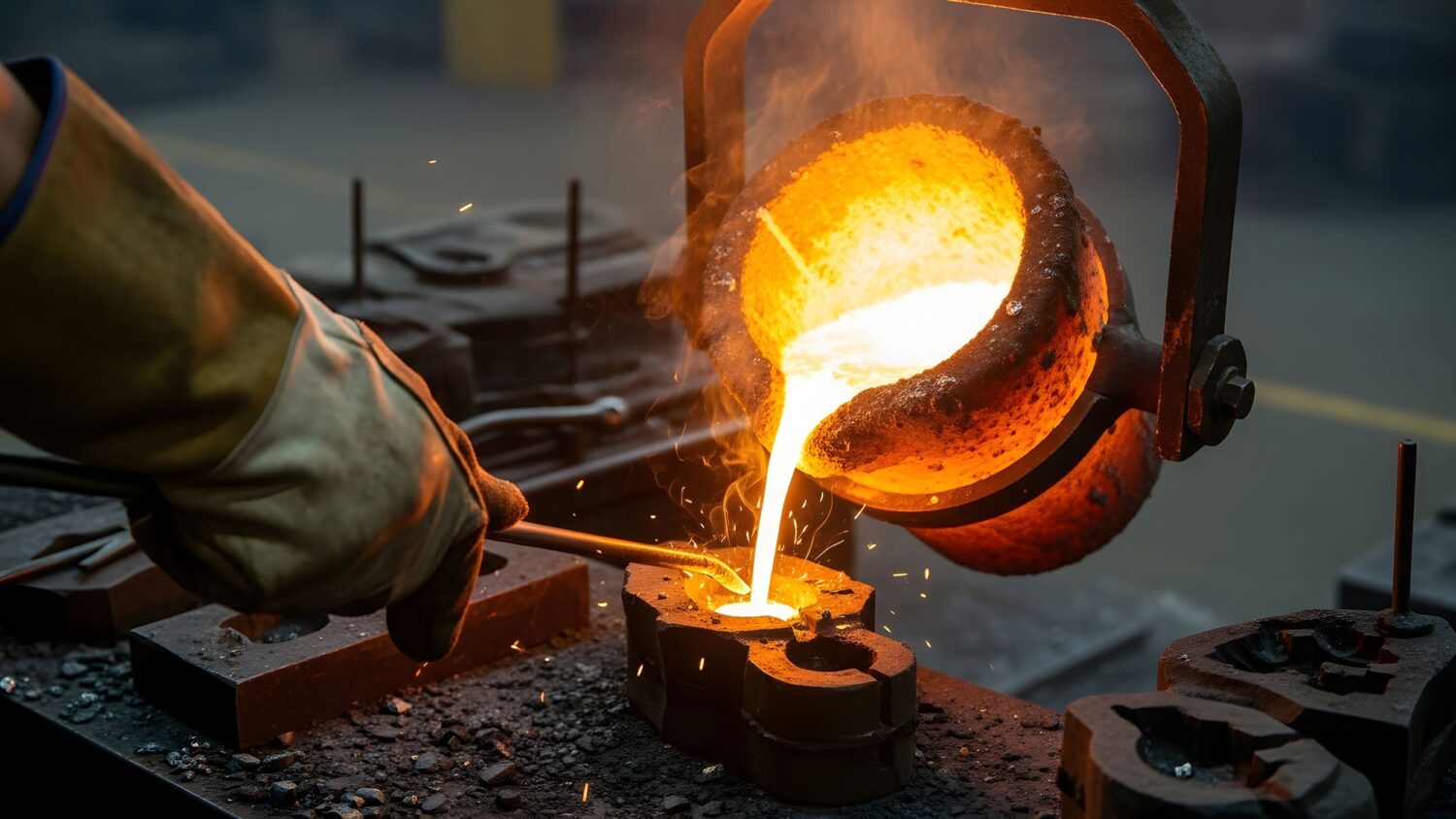
Cast iron is a good alternative to steel in many applications. It melts at a lower temperature and has good castability and machinability. It can also be strong and wear-resistant, or dampen noise and vibration, but these depend on the type of cast iron chosen.
Cast iron can be produced in either gray or ductile forms. The difference is in how the excess carbon is incorporated into the metal matrix. This blog compares the two so buyers, engineers, and quality professionals can understand the differences.
Definition and Composition of Gray and Ductile Cast Iron
Most steels have less than 1% carbon. When carbon content exceeds 2%, it forms flakes of graphite under specific cooling conditions. This is what’s called gray cast iron.
Graphite flakes dramatically reduce ductility and tensile strength. They are avoided by encouraging the excess carbon to form spherical nodules. This is achieved by adding a trace amount of magnesium just before the liquid iron is poured, a process known as inoculating. These nodules result in ductile cast iron.
Mechanical Properties Comparison
Gray cast iron has very low ductility and tensile strength, and essentially zero yield strength. It also lacks any toughness, fracturing under even very light impacts. It does, however, have good compressive strength, high thermal conductivity and is readily machined. An additional uncommon property is an ability to dampen noise and vibration.
In contrast, the ductility and tensile strength of ductile cast iron are close to that of steel. It’s also very tough, as evidenced by a high impact strength. Plus, fatigue resistance is increased because it lacks the crack initiation points that graphite flakes create. Wear resistance is also good, but there’s less damping ability and lower thermal conductivity.
Applications in Industry
While applications for gray cast iron and ductile cast iron overlap, there are also some important differences. The biggest is that gray should not be used in applications where it will come under tensile or impact loads.
Gray cast iron applications include:
- Hardscaping components (grates, manhole covers, and similar)
- Counterweights
- Machine tool bases
- Some housings, such as for gearboxes, where noise reduction is beneficial
- Engine parts requiring good thermal conductivity (cylinder liners, for example)
- Some brake components
Ductile iron is used in engineered applications, like:
- Valves
- Couplings
- Machine components
- Oil and gas extraction hardware
- Brackets
- Gears
Advantages and Disadvantages
Cast iron melts at around 2,200° Fahrenheit, or some 500 degrees lower than steel. That makes it easier to cast. Gray iron also has good castability, while ductile iron can require more care and precision, (plus it needs inoculating).
Gray iron is also very machinable and can be a cost-effective choice in the applications listed above. The vibration damping capabilities also make it an attractive choice in many engine and braking applications.
In contrast, ductile iron is typically more expensive material to purchase due to melt addition, although it can be the better choice for engineered applications.
Enhancing Material Properties
As with steels, the properties of cast iron can be improved with heat treatment. This is done primarily with ductile cast iron.
Austempering, which entails a salt bath quench, is done to raise tensile strength and toughness. Ductile iron may also be normalized to improve uniformity throughout the structure and so raise tensile strength slightly.
Foundry Processes and Manufacturing
Producing high-quality cast iron requires precise control throughout the foundry. For gray iron, silicon and carbon are added to promote graphite flake formation. For ductile, it’s essential to minimize sulfur as this reduces nodule formation.
Both metals are poured into molds to create the shapes required. The difference is that ductile iron is inoculated with magnesium immediately prior to pouring, as this moves the graphite to form spheres.
Cooling rates have a significant impact on final properties. For gray iron, slower cooling forms larger flakes, which improves vibration damping. In ductile iron, cooling rate alters the ratio of ferrite and pearlite, with more pearlite meaning less ductility.
Understanding Gray Cast Iron vs. Ductile Cast Iron
While sometimes considered an “old” material, the properties of cast iron make it a good choice in a range of applications. However, it’s important to understand the differences between the two main types.
Ductile iron casting, a relatively recent process innovation, offers good tensile strength and toughness, thanks to graphite forming into spheres rather than flakes. In contrast, gray iron casting, the older process, yields a brittle material with good thermal conductivity and the ability to dampen vibration.
Looking ahead, cast iron is widely seen as a sustainable material, thanks to the ease with which it can be recycled. This, plus continuing improvement in ductile iron properties, are the major trends to anticipate in the future.