
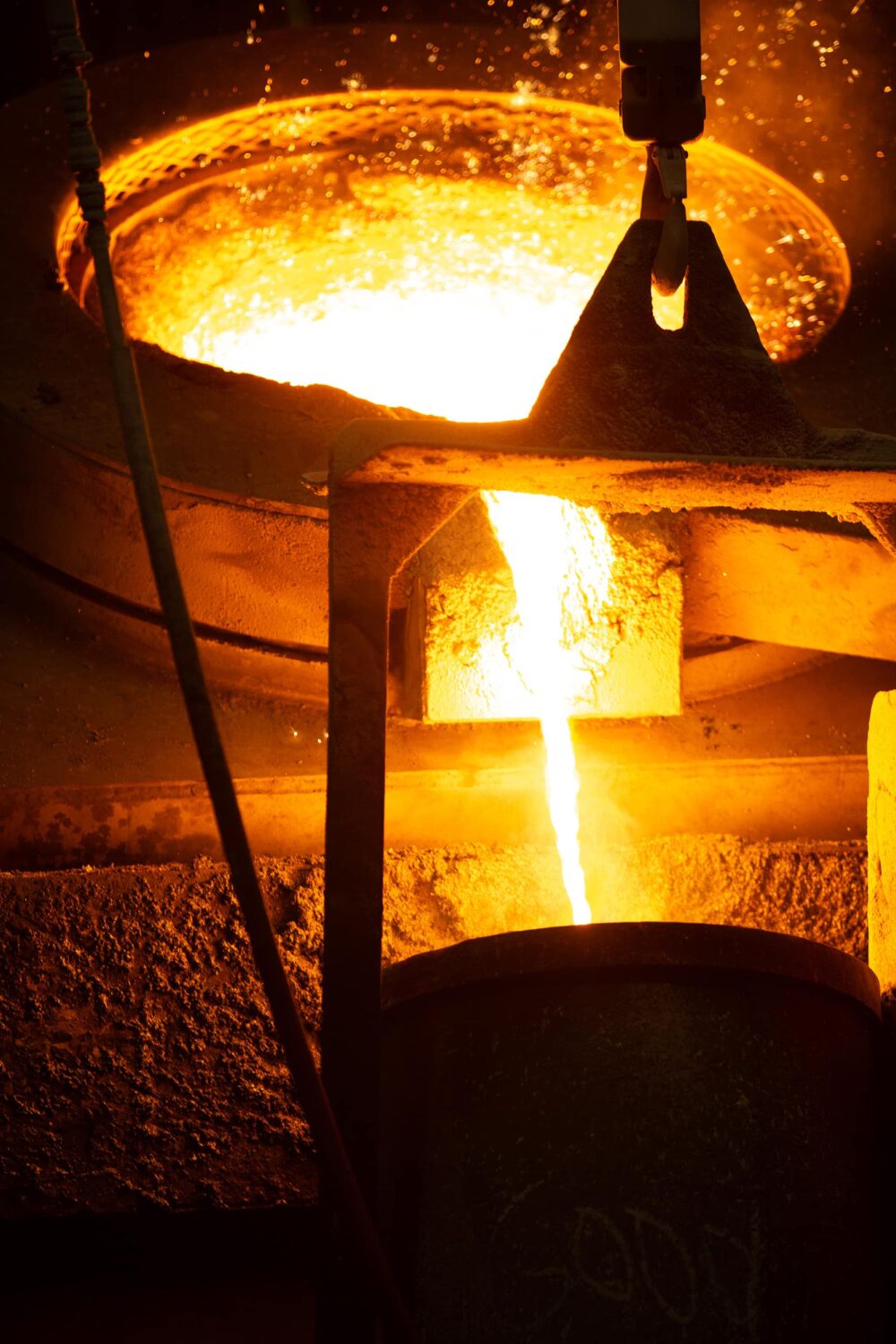
Iron casting remains one of the most widely used and enduring manufacturing processes in modern industry. It involves pouring molten iron into a prepared mold, where it solidifies into a final shaped component used in many applications: structural, mechanical, and high load. While the process itself is conceptually simple, the engineering behind it has evolved over time.
Iron casting dates back thousands of years when early civilizations first learned to melt and shape iron into tools and structural objects. As furnace technology improved, casting expanded into more complex applications. By the Industrial Revolution, it became a foundational process for machinery and transportation systems, along with infrastructure development.
Modern iron casting is far more controlled and precise. Simulation tools, improved furnace systems, advanced molding techniques, and other advances have made it possible to get consistent quality across large production volumes. Certain methods – such as shell molding – are now commonly used in applications where tighter tolerances and smoother surface finishes are required, especially in precision components where repeatability matters.
It also remains highly adaptable, allowing manufacturers to produce both simple and highly complex geometries, depending on application needs.
Key Advantages of Iron Casting Over Other Materials
Iron casting is often selected over aluminum or steel when long-term stability and vibration control, along with lifecycle cost efficiency, are more important than weight savings or maximum tensile strength. It performs well in environments exposed to continuous mechanical load and thermal variation.
Mechanical Performance Advantages
- High vibration damping reduces structural stress and operational noise
- Strong compressive strength supports heavy mechanical loads
- Excellent wear resistance extends service life in abrasive environments
- Stable thermal response reduces distortion during temperature cycling
- Predictable fatigue behavior improves long-term reliability
- Internal graphite structure helps dissipate mechanical energy
- Reduced resonance improves system-wide stability
- Better tolerance to micro-defects in real-world operating conditions
Cast iron’s vibration damping capability is one of its most valuable properties. Rather than transmitting vibration through a structure, it absorbs energy internally, reducing resonance and protecting connected components from fatigue damage. In many industrial machines, this directly translates into improved accuracy. Certain equipment (CNC machines, compressors, and rotating assemblies) benefits from reduced micro-vibration that would otherwise accumulate into alignment drift over time.
Cast iron also behaves in a stable and predictable way under long-term stress exposure. Unlike materials that may gradually deform or relax, cast iron tends to stabilize in performance once it has been properly loaded and conditioned.
Manufacturing and Lifecycle Advantages
- Cost-effective production across prototypes and mass production
- Good machinability reduces finishing time and tool wear
- Ability to form complex geometries reduces assembly requirements
- High repeatability supports consistent production output
- Long service life reduces maintenance frequency
- Stable casting behavior improves yield consistency
- Reduced need for redesign across product generations
- Efficient scalability for both small and large production runs
From a lifecycle standpoint, the benefits of iron casting reduce total system cost through material affordability and lower maintenance requirements, along with reduced replacement frequency.
The Iron Casting Process
Iron casting is a multi-stage manufacturing process combining engineering design and metallurgical control with precision production systems.
Pattern and Tooling Development
The process begins with creating a pattern that defines the final geometry of the part. Engineers use CAD modeling and simulation tools to optimize design and predict metal flow, reducing casting defects. Key considerations include shrinkage compensation and wall thickness uniformity, along with gating system design. These directly influence how molten iron fills the mold and how it behaves during solidification.
For components requiring higher dimensional control or repeatable surface quality across production batches, shell molding becomes especially relevant. Its rigid mold structure reduces pattern deformation and helps maintain tighter geometric consistency without requiring extensive post-machining correction.
Mold Preparation
Molds are created using either sand casting or more controlled molding techniques depending on application requirements. Sand casting is typically used for larger components where flexibility and lower tooling cost are priorities. But when dimensional repeatability and surface finish consistency or reduced machining allowance are more important, shell molding is often preferred due to its stiffer mold shell and improved dimensional stability.
Mold rigidity plays a major role in final accuracy. More rigid molding systems reduce deformation during pouring, directly improving consistency between parts and reducing variation in downstream machining.
Melting and Material Preparation
Iron is melted in controlled furnace environments where temperature and chemical composition are carefully managed. Carbon levels and alloying elements are adjusted to achieve required mechanical properties. Modern foundries increasingly rely on real-time chemical monitoring to ensure that each batch of molten iron meets strict specifications before pouring begins. Process standardization across shifts and production lines ensures that components remain consistent even when produced at scale in different environments.
Another important factor is melt cleanliness. Inclusion control is needed, since impurities can reduce fatigue life in high-stress applications.
Pouring and Solidification
Molten iron is poured into molds where it begins to solidify. Its cooling rate strongly influences grain structure and residual stress, along with final mechanical behavior. Controlled gating systems help ensure smooth flow and reduce turbulence, minimizing defects, such as porosity or incomplete filling. Uniform cooling is important in thick sections where uneven solidification can create internal stress or distortion. Engineers often design risers specifically to compensate for shrinkage during cooling.
Applications of Iron Casting in Various Industries
Automotive Systems
Iron casting is widely used in automotive systems for certain components (engine blocks, brake components, and transmission housings) where thermal stability and vibration damping are needed. Engine blocks benefit from cast iron’s ability to maintain dimensional stability under repeated heating and cooling cycles, helping preserve sealing performance and reducing long-term distortion. Brake components also rely on its thermal mass to help dissipate heat during repeated braking events and reduce fade under heavy use.
Heavy Equipment
Heavy equipment relies on cast iron for structural frames and gear housings, along with hydraulic systems that must operate under continuous high load conditions. In these environments, stiffness and resistance to deformation are often more important than weight especially in stationary or semi-mobile machinery where stability directly impacts performance and safety. Cast iron’s compressive strength ensures components maintain alignment even under sustained mechanical stress.
Agricultural Machinery
Agricultural machinery uses cast iron in environments exposed to soil abrasion and outdoor conditions where durability is a must. Components, such as housings and drive assemblies, must tolerate dirt intrusion and moisture, along with uneven loading, without losing alignment or requiring frequent replacement. Its resistance to wear and gradual degradation makes it especially suitable for long operating seasons with minimal maintenance downtime.
Industrial Machinery
Industrial machinery applications include machine bases and compressor housings, along with tooling structures, where vibration control directly impacts precision. In machining environments, the rigidity of cast iron bases helps maintain tool alignment during high-speed cutting operations, reducing dimensional variation in finished parts.
In components where tighter tolerances are required – precision housings, alignment-critical mounts, repeatable interface geometries – manufacturers often rely on more dimensionally stable casting approaches like shell molding to reduce post-processing and maintain consistency across production runs.
Energy Systems
Energy systems, such as pumps and generators or turbine housings, rely on cast iron for maintaining alignment under continuous rotational loads. Even small deviations in concentricity can reduce efficiency or increase wear over time, making material stability a key design factor. Cast iron helps maintain structural integrity under continuous cycling conditions, supporting long-term operational reliability in energy generation and fluid movement systems.
Mining and Material Handling
Mining and material handling systems use cast iron for crusher housings, conveyor frames, structural supports, and similar applications exposed to high impact and abrasive environments. These systems benefit from cast iron’s ability to resist both surface wear and internal fatigue under repeated shock loading. Its durability helps reduce unexpected downtime in operations where equipment failure can disrupt production flow.
Automated Manufacturing Systems
In automated manufacturing systems, cast iron machine bases help reduce vibration in CNC machines and robotic equipment, improving consistency and reducing calibration drift over time. For high-precision automation components where repeatability between identical parts is needed, shell-molded castings are often favored since they help maintain tighter dimensional control and reduce variability that could otherwise accumulate in high-speed production environments.
Environmental Benefits and Sustainability of Iron Casting
Iron casting supports sustainability through recyclability and long service life, along with efficient use of raw materials. Since iron can be recycled repeatedly without losing its core mechanical properties, scrap from machining and end-of-life components can be reintroduced into production cycles. This reduces dependence on virgin ore and helps stabilize material demand in large-scale manufacturing.
Material Efficiency Benefits
- Fully recyclable without loss of structural performance
- High scrap reuse reduces reliance on virgin raw materials
- Closed-loop recycling supports circular manufacturing systems
- Near-net-shape production reduces machining waste
A key advantage is material efficiency during production. Since castings are formed close to final geometry, less material is removed during machining compared to subtractive manufacturing methods. This reduces scrap generation and improves overall resource efficiency.
Production Efficiency Benefits
- Reduced machining requirements lower material waste
- Sand reclamation systems allow reuse of molding materials
- Improved furnace efficiency reduces energy consumption
- Optimized processes reduce defect-related scrap
Modern furnace systems and process controls also improve energy efficiency, stabilizing melt cycles and reducing overheating. Shell molding contributes indirectly, improving dimensional consistency and reducing rework and wasted energy in secondary operations.
Lifecycle Sustainability Benefits
- Long service life reduces replacement frequency
- Gradual wear supports planned maintenance cycles
- Fewer replacements reduce logistics emissions
- Predictable performance reduces emergency production needs
A major sustainability benefit comes from predictable wear behavior. Components degrade gradually rather than fail suddenly, allowing maintenance to be planned rather than reactive. This reduces emergency production and lowers supply chain inefficiencies over time.
Quality Control and Defect Prevention in Iron Casting
Quality control in iron casting ensures that components meet strict mechanical and dimensional requirements throughout production. Since cast parts are often used in high-load and vibration-sensitive applications, preventing defects is required for long-term performance. Common defects include porosity, shrinkage, inclusions, and misruns. These typically originate from variations in temperature control, alloy composition, mold quality, or cooling conditions. Preventing them requires tight process control rather than relying only on final inspection.
Process Stability and Control
Furnace temperature and chemical composition are continuously monitored to maintain consistency across batches. Even small variations in carbon or silicon content can affect hardness and machinability, along with fatigue resistance. Mold integrity is also needed, as variations in mold structure can directly affect surface finish and dimensional accuracy. In tighter tolerance applications, the inherent rigidity of shell-molded molds helps reduce dimensional drift during pouring and cooling, supporting more consistent outcomes before inspection even begins.
Inspection and Verification Methods
Inspection methods include ultrasonic testing and radiographic analysis, along with coordinate measurement systems. These allow detection of both internal and external defects without damaging components. Dimensional verification is especially important for parts used in assemblies where tight tolerances are required. Even minor deviations can affect alignment and wear patterns along with long-term system performance.
Material testing is also used to confirm hardness and structural consistency, ensuring that components meet design specifications before they’re released for use.
Scaling and Repeatability
As production scales, maintaining consistency becomes more challenging. Standardized procedures and automated controls help reduce variation between shifts and production lines. Rather than relying solely on end-stage inspection, modern systems use feedback from production data to adjust parameters in real time. This improves yield consistency and reduces scrap rates across high-volume manufacturing.
Precision Manufacturing Built on Iron Casting Excellence
Iron casting remains a foundational industrial process, providing strength, durability, vibration damping, and cost efficiency in a single material system. Advancements in simulation, automation, and molding techniques continue to improve precision and repeatability. In fact, shell molding is one of several methods used when tighter dimensional control and consistent surface quality are required.
As manufacturing continues to evolve, iron casting remains a core process that bridges traditional mechanical strength with modern engineering precision. For manufacturers seeking reliable production methods, shell mold casting supports precision-focused manufacturing approaches. Hiler Industries provides high-quality engineered materials designed for demanding industrial applications.