
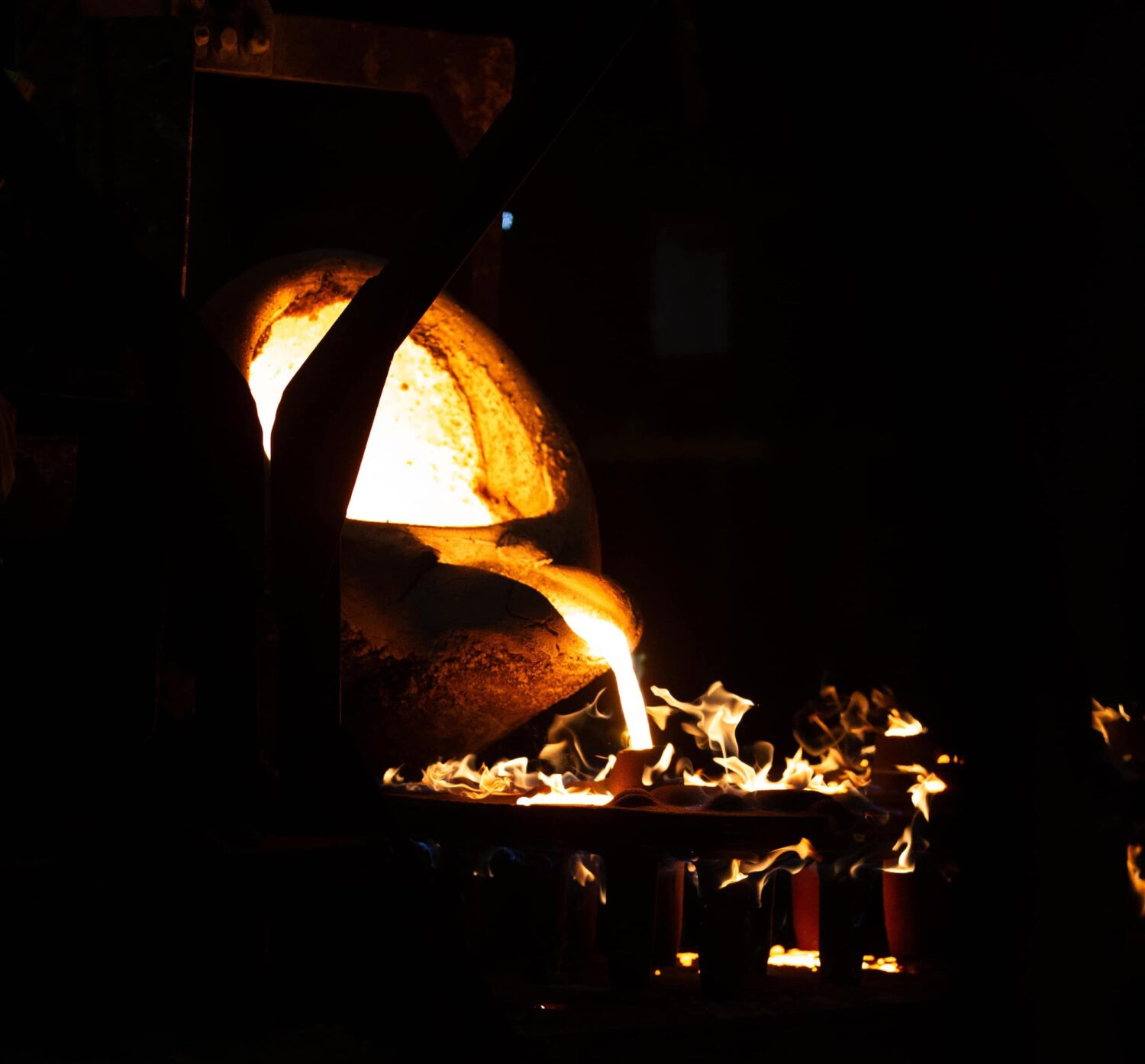
Austempering is a specialized heat treatment that enhances the performance of ferrous metals. It’s widely used when parts need a balance of strength and toughness, along with dimensional stability.
Unlike conventional heat treatments, austempering delivers high mechanical performance while minimizing distortion. That makes it ideal for components that need to meet tight tolerances without sacrificing durability.
As manufacturers push for stronger and lighter components with higher efficiency, austempering has become an increasingly important process. It allows engineers to meet demanding performance requirements while maintaining design flexibility and cost control, especially when working with cast iron components.
The Austempering Process Explained
The austempering process is a tightly controlled heat treatment that’s most commonly applied to iron-based alloys, such as ductile iron. Its primary purpose is to transform the metal’s internal microstructure into a form that delivers high strength and toughness while reducing the risks associated with rapid cooling.
The process begins with heating the iron casting to the austenitizing temperature range. At this stage, the metal’s structure becomes fully austenitic, that is, carbon is evenly distributed throughout the matrix. Uniform austenite formation is important since it directly influences consistency in the final mechanical properties.
After austenitizing, the casting is quickly transferred into a molten salt bath rather than quenched in oil or water. The salt bath is held at an intermediate temperature (typically between 450 and 750 degrees Fahrenheit) depending on the desired balance of strength and ductility. This controlled quench avoids the formation of brittle martensite.
Key steps in the austempering process for iron include:
- Heating the casting until austenite is fully formed
- Rapid transfer into a precisely controlled salt bath
- Isothermal holding to allow transformation into ausferrite
- Cooling to room temperature without additional phase changes
During the isothermal hold, the austenite transforms into ausferrite: a microstructure composed of acicular ferrite and carbon-stabilized austenite. This structure is responsible for the hallmark properties of austempered ductile iron, including its ability to combine strength with flexibility.
Compared to traditional quench-and-temper treatments, austempering introduces significantly lower internal stresses. Reduced stress improves dimensional stability, making the process especially valuable for complex geometries and thin sections or components with tight tolerances.
Steel can also be austempered, but the process window is narrower and less forgiving. Steel often requires stricter temperature control and may still need secondary processing to achieve comparable toughness. Ductile iron responds well due to graphite nodules that help inhibit crack growth and enhance fatigue resistance.
Other ferrous alloys can undergo austempering or similar isothermal treatments. But ductile iron remains the most widely used material since it combines castability and predictable performance with cost efficiency.
Benefits of Austempering
Austempering offers a wide range of mechanical and manufacturing advantages that extend beyond simple strength gains. These benefits make it a preferred heat treatment for demanding applications.
High Strength and Load Capacity
Austempered components can achieve tensile and yield strengths comparable to many alloy steels. This allows parts to handle high static and dynamic loads without excessive material thickness.
The high strength-to-weight ratio also enables lighter designs. Reducing weight without sacrificing performance is especially valuable in transportation equipment, off-highway and rotating machinery, and other weight-sensitive applications.
Enhanced Ductility and Toughness
Unlike many high-strength materials, austempered ductile iron maintains excellent ductility. Components can deform under stress rather than failing suddenly, improving safety and reliability.
Toughness is also improved, especially at lower temperatures. This makes austempered parts suitable for applications where brittle fracture may be a concern, such as outdoor, seasonal, and cold climates.
Improved Fatigue Resistance
Fatigue performance is one of the most important benefits of austempering. The ausferritic microstructure distributes stresses more evenly across the component, so austempered parts typically perform well under repeated loading cycles. This is important for components that experience constant motion, for example, gears, suspension parts, and power transmission elements.
Better Impact Resistance
Another important benefit is improved impact resistance under real-world operating conditions. Austempered components are better able to handle sudden load changes and shock events, along with unpredictable stresses, making them more reliable in applications where operating conditions vary or can’t be tightly controlled.
Dimensional Stability and Reduced Distortion
Since austempering avoids rapid thermal shock, components experience minimal warping during heat treatment. This dimensional stability is especially beneficial for precision castings with complex shapes. Reduced distortion translates to fewer corrective machining steps and improved repeatability along with more predictable production outcomes.
Wear Resistance and Service Life
Austempered materials offer strong resistance to abrasive and adhesive wear. This makes them well-suited for components exposed to friction and contact stress or harsh operating environments. Improved wear resistance extends service life and reduces maintenance requirements, while lowering the total cost of ownership over the lifespan of the component.
Applications of Austempered Materials
Austempered materials are used across a wide range of industries where strength and durability are a must. Their versatility allows them to serve both heavy-duty and precision applications.
Common applications include:
- Automotive components, such as gears, differential housings, and suspension and drivetrain components
- Agricultural and construction equipment exposed to shock loading and abrasive conditions
- Power transmission components, like sprockets, hubs, pulleys, and couplings
- Industrial machinery parts requiring high fatigue strength and long service life
- Rail, defense, heavy vehicle components operating under extreme loads
In automotive manufacturing, austempered ductile iron is frequently used to replace forged or machined steel parts. This substitution reduces vehicle weight while maintaining strength and safety margins.
Agricultural and construction equipment benefit from austempered components since they can absorb impact and resist cracking under repeated loading. This durability helps reduce downtime and extend service intervals.
In industrial machinery, austempered parts perform well in continuous-duty environments. Their fatigue resistance and wear properties make them suitable for gears, housings, structural components, and similar machinery that operate around the clock.
Why Austempering Matters for Modern Manufacturing
Modern manufacturing places increasing pressure on materials to deliver higher performance — while controlling costs and complexity. Austempering directly addresses these challenges.
Key reasons why austempering matters today include:
- Enabling iron castings to replace heavier or more expensive steel components
- Delivering consistent mechanical properties through a single heat treatment
- Supporting lightweighting initiatives without sacrificing durability
- Reducing machining, rework, and overall production costs
- Improving component lifespan and sustainability outcomes
The austempering process provides manufacturers with a predictable and repeatable way to achieve strength and ductility, along with toughness. This consistency improves quality control and reduces variability across production runs.
From a design perspective, austempering gives engineers greater freedom. Components can be optimized for performance rather than overbuilt for safety margins without compromising reliability. This enables thinner sections and integrated features, along with reduced part counts.
Extending component life and reducing material waste allows austempering to support sustainability goals. Longer-lasting parts require fewer replacements, lowering resource consumption over time.
The Bottom Line on Austempering and Metal Casting
Austempering is a proven heat treatment that enhances strength, ductility, wear resistance, and dimensional stability in ferrous metals. It’s especially effective for producing high-performance austempered ductile iron components.
Hiler Industries offers a wide range of metal pouring capabilities, including austempered ductile iron, to support demanding applications across industries. Contact us to discuss your project and learn how advanced heat-treated castings can elevate your next design.